Kogi East APC Legacy Group Launches Town Halls for Grassroots Development
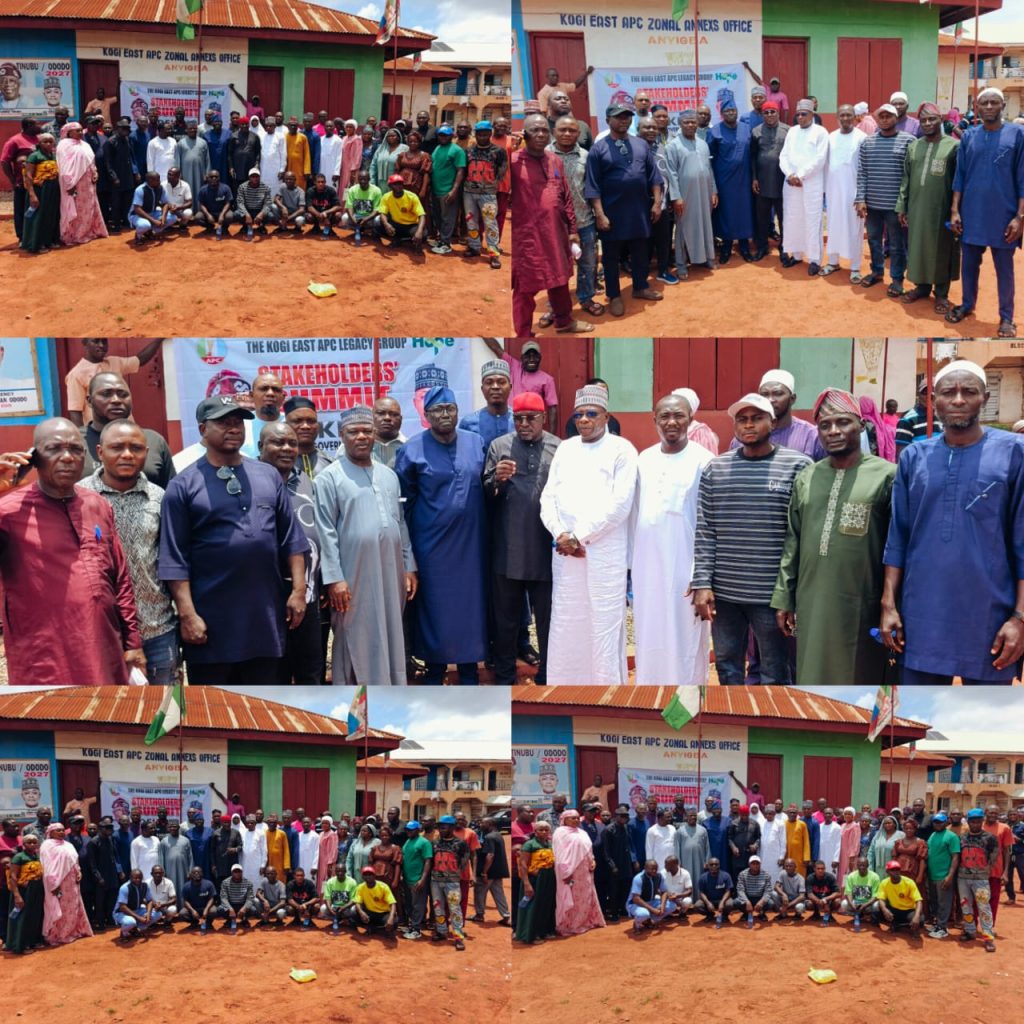
Stakeholders at a Kogi East APC Legacy Group town hall meeting discussing grassroots development priorities.
The Kogi East APC Legacy Group has launched a series of grassroots town hall meetings across the nine local government areas of Kogi East Senatorial District, with a focus on development priorities, political engagement and stronger alliances across Kogi State.
The initiative began with meetings in Dekina and Bassa Local Government Areas, where the group brought together ward-level stakeholders, political veterans and other community representatives to discuss infrastructure, public accountability, power-sharing and cooperation among the three senatorial districts.
The group said Kogi East, being the state’s most populous senatorial district and largest voting bloc, has significant political influence but cannot independently satisfy the constitutional requirement for statewide spread in a governorship election.
Under Section 179(2) of the 1999 Constitution, a governorship candidate must secure the highest number of votes and at least 25 per cent of votes cast in at least two-thirds of the local government areas of the state.
With Kogi State comprising 21 local government areas, the group said a candidate needs to meet the 25 per cent threshold in at least 14 LGAs, making alliances with Kogi Central and Kogi West important to any political strategy centred on statewide support.
The group said the town halls were designed to promote what it described as a development-focused approach to politics, involving sustained engagement with government and negotiations around infrastructure and other community needs.
Speaking during the engagements in Dekina and Bassa, Mr Dan Okolo, a leader of the group and a former Director-General of Information in Kogi State, said grassroots development should remain the district’s foremost priority.

Okolo, a former commissioner and special adviser to different administrations in the state, called for sustained engagement with governments at all levels to address infrastructure deficits, improve living conditions and promote equitable access to political and development opportunities.
He said durable relationships between Kogi East, Kogi Central and Kogi West were necessary to advance shared development objectives.
Okolo also said the group’s engagement with Governor Ahmed Usman Ododo had resulted in attention to some of the infrastructure requests it had presented to the state government.
Among the projects cited were the proposed 37-kilometre Idah–Onyedega Road in Ibaji and the 13-kilometre Odenyi–Oguma–Sheria Road in Bassa.
The Kogi State Government has advertised the two projects for competitive bidding through the Ministry of Works, alongside another road project in Kabba/Bunu.
Okolo said the group would continue to monitor the procurement process, contract awards and execution of projects in critical areas.
He also disclosed that 12 solar-powered water schemes had been approved for Kogi East, with four each allocated to Bassa, Ibaji and Omala local government areas.
According to him, the four projects in Bassa are serving Mozum, Gboloko, Oguma and Ikende, while work had commenced on the Bassa schemes and the geophysical survey had been completed.
The group said it had advocated the water projects because of the inadequate access to water in the affected communities.
Okolo further said the state government had approved the reconstruction of nine secondary schools in Kogi East under the World Bank-assisted AGILE programme, with one project allocated to each of the district’s nine local government areas.
He said the distribution of the projects across the nine LGAs was important for equitable access to education and added that other requests submitted by the group were also receiving government attention.
The group said its approach was influenced by the political legacy of the late Prince Abubakar Audu, whom it described as a leader who promoted political relationships across Kogi State and pursued development across the three senatorial districts.
It said political discussions should focus on the welfare of residents, unity of the state and equitable distribution of public amenities rather than individual political interests.
Alhaji Abdullahi Haruna, SAN, who served as Solicitor General during Audu’s first administration in 1992 and Attorney General between 1999 and 2003, urged stakeholders to strengthen links between citizens and government.
Haruna said the town halls were intended to provide a platform for residents to identify their most pressing needs and for stakeholders to engage government on possible solutions.
He said politics should be tied to public service and tangible improvements in people’s lives.
Haruna also called for greater unity among the people of Kogi State, arguing that ethnic and political rivalries could undermine development efforts.
He cited the development of the Obajana Cement project as an example of a major project that, according to him, faced political opposition before eventually expanding significantly.
At the Dekina meeting, a former Majority Leader of the Kogi State House of Assembly, Hon. Moses Idoko Ododo, called for greater emphasis on development rather than individual political ambitions.
He said Kogi East had experienced setbacks and that the district should support efforts directed at addressing its development challenges.
In Bassa, Hon. Salisu Adakeke, also a former Majority Leader of the Kogi State House of Assembly and a longtime supporter of the late Prince Abubakar Audu, commended the government’s attention to infrastructure concerns raised by stakeholders.
Adakeke welcomed the interventions in Bassa and said continued development efforts could strengthen public support for the APC.
The Kogi East APC Legacy Group said its development agenda extends beyond the projects already receiving attention.
Its outstanding requests include a national electricity transmission substation in Kogi East, sustainable rural water schemes, rehabilitation and equipping of general hospitals, and phased improvements to public primary and secondary schools.
The group also listed the Ankpa–Abejukolo, Anyigba–Iyale–Abejukolo and Ejule–Alloma–Otukpa Junction roads among its priority road projects.
It called for continued engagement with the Federal Government on the Itobe–Anyigba–Ankpa–Otukpa, Idah–Odolu–Nsukka and Dekina–Shintaku corridors.
On security, the group called for stronger protection in boundary communities, farming areas and along major transit routes.
It also urged authorities to ensure that communities hosting coal mining activities in Ankpa and oil extraction in Ibaji receive visible and equitable benefits from those resources.
The group concluded the town hall engagements by urging ward leaders to strengthen party cohesion, maintain dialogue with their communities and channel local development priorities through appropriate party and government structures.
It said the town hall programme would continue across the remaining local government areas of Kogi East as part of efforts to sustain grassroots engagement and build relationships with stakeholders across Kogi East, Kogi Central and Kogi West.
Report by Johnson Musa, PhD
About Post Author