Ododo Backs Kogi Unity Accord, Seeks Lasting Framework for Peace
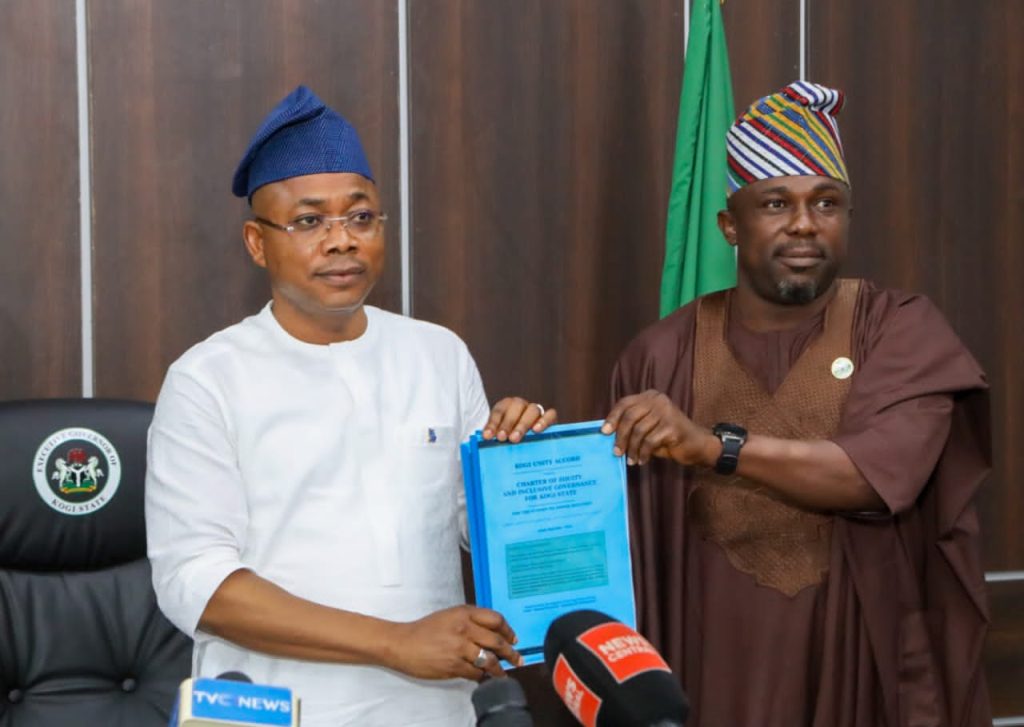
Governor Ahmed Usman Ododo receives the Kogi Unity Accord Committee report from its chairman, Bode Adeyemi, at Government House, Lokoja.
Kogi State Governor, Ahmed Usman Ododo, has backed the Kogi Unity Accord initiative, urging stakeholders to work together towards a lasting framework for peace, equity and sustainable development in the state.
Ododo made the call on Tuesday at the Government House, Lokoja, while receiving the report of the Kogi Unity Accord Committee, chaired by Hon. Bode Adeyemi, following its consultations across the state and a two-day summit on power and resource allocation.
The governor said the initiative provided an opportunity for Kogi stakeholders to address longstanding divisions and establish a framework that would serve both present and future generations.
He urged the committee to expand its consultations by making the documents available to former governors, political leaders, members of the National Assembly and State House of Assembly, traditional rulers, retired public servants and other critical stakeholders.
Ododo stressed that any agreement reached must be properly documented and capable of standing the test of time, rather than serving as a temporary solution.
“I will not be party to something that will solve a problem now and create a major problem for the future generation,” the governor said, calling for continued consultation and a properly documented consensus.
He also urged Kogi people to change their perception of the state’s resources, arguing that natural resources should not be viewed primarily through the lens of geographical location or ethnic affiliation.
Ododo cited mineral resources, including coal, lithium and gold, as common assets that should be harnessed for the benefit of all residents of the state.
“This is not about politics. Whether APC, whether PDP, it is about Kogi,” he said.
The governor described the Unity Accord as an initiative that transcended partisan politics, noting that participants were drawn from different political parties and sections of the state.
He also acknowledged the contributions of past leaders to the development of Kogi, stressing that the actions of political leaders while in office ultimately form part of their legacy.
Earlier, Adeyemi said the Kogi Unity Accord Committee was established to develop a pathway towards unity, equity and inclusive governance in response to ethnic suspicion and political divisions that had characterised aspects of leadership recruitment in the state.
He said the committee had undertaken consultations before the wider state-level summit, including senatorial summits in Kogi West and Kogi East.
According to Adeyemi, the committee subsequently visited the 21 local government areas, engaging traditional rulers, religious leaders, community development associations, professional bodies, civil society organisations and other stakeholders.
He said the consultations showed that ordinary Kogi people were largely united, while political competition had contributed to divisions among them.
Adeyemi said the summit provided an opportunity for stakeholders to discuss how political power and resources could be distributed more equitably without allowing political competition to undermine the unity of the state.
He disclosed that the two-day summit, held on September 30 and October 1, produced three major documents: the summit report, a communique and the October 1 Accord, which he described as the Charter of Equity and Inclusive Governance for Kogi State.
According to him, the documents reflected contributions and positions from stakeholders across the state, while the committee also retained video evidence of contributions made during the summit.
Adeyemi said the committee would formally transmit the documents to the Kogi State House of Assembly, the State Council of Traditional Rulers and other relevant stakeholders for further consideration and eventual implementation.
He said the next phase of the initiative would involve further engagement with critical stakeholders, with the ultimate objective of establishing a system under which every part of Kogi State could benefit from equitable development regardless of who occupies the governorship.
Adeyemi described the initiative as a new phase in efforts to promote unity in Kogi and expressed optimism that the process would provide a workable framework for addressing recurring political tensions in the state.
About Post Author