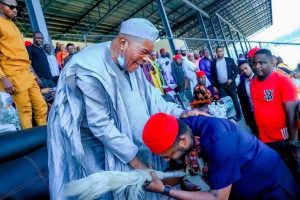
Okene’s Rice Mill: A New Normal

By Amb. Abdullahi Ismaila Abdulkadir
Secretary General, NYCN Kogi State Chapter
Amb. Abdullahi Ismaila Abdulkadir is a former student leader, a foremost youth leader, and a respected opinion moulder whose commitment to youth development and socio-economic advancement in Kogi State has remained unwavering.
In a state richly blessed with abundant natural and human resources, it is both surprising and concerning that much of our private investment culture has long revolved around conventional ventures such as hotels and filling stations. While these businesses are not without merit, they often do little to transform the productive capacity of our economy or create sustainable value chains.
It is against this backdrop that the recent test run of Khalifa Abdulrahman Okene’s rice mill stands out as a bold, refreshing, and commendable shift, a true signal of what I describe as a new normal for Kogi State.
This initiative is not just about rice processing; it represents a mindset change. It demonstrates that our wealthy and financially capable individuals can channel their resources into agro-processing and industrial ventures that directly impact livelihoods, reduce dependency, and stimulate economic growth.
Kogi State is uniquely positioned for such transformation. With vast arable land and favorable climatic conditions, rice production alone holds immense potential. By investing in rice mills, we are not only encouraging local farmers but also creating jobs across the value chain, from cultivation to processing, packaging, and distribution.
Beyond rice, Kogi is richly endowed with other resources that remain underutilized:
- Coal deposits in the state present opportunities for energy generation. With the global demand for alternative energy sources, strategic investment in coal-based power generation can significantly boost electricity supply and industrial growth.
- Cashew production, already prominent in parts of the state, offers enormous potential. Instead of exporting raw cashew nuts, investors can establish processing plants to produce cashew kernels, oil, and other by-products. This will increase revenue, create jobs, and position Kogi as a hub for agro-industrial processing.
- Solid minerals such as limestone, iron ore, and others provide a strong foundation for manufacturing and industrialization if properly harnessed.
The challenge before us is not the absence of opportunities but the lack of deliberate investment in sectors that multiply value. The era where wealth is merely showcased through physical structures with limited economic ripple effects must give way to an era of productive enterprise.
Khalifa Abdulrahman Okene’s rice mill is therefore more than a project, it is a call to action.
It calls on our political leaders, business elites, and young entrepreneurs to rethink priorities. It challenges us to move from consumption-driven investments to production-driven ventures. It urges us to build industries that will outlive us and sustain generations to come.
As youths, we must also begin to align our aspirations with innovation, enterprise, and productivity. Government alone cannot drive development; it must be a collective responsibility.
In conclusion, the emergence of this rice mill should not be seen as an isolated effort but as the beginning of a movement, a new economic direction for Kogi State. Let it inspire replication across our senatorial districts and beyond.
Indeed, this is the new normal we must all embrace.
About Post Author