PAAU VC Calls for Industry-Led TVET Reforms in Nigeria
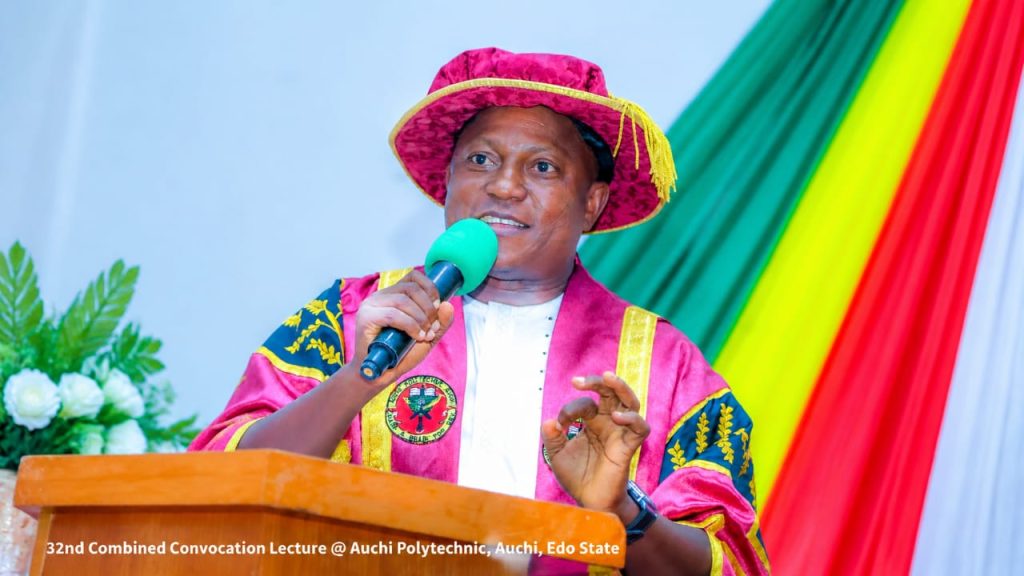
Professor Salisu Ogbo Usman delivering the 30th–32nd Combined Convocation Lecture at Auchi Polytechnic, Auchi, Edo State, on November 27, 2026.
The Vice-Chancellor of Prince Abubakar Audu University (PAAU), Anyigba, Professor Salisu Ogbo Usman, has called for far-reaching reforms in Nigeria’s Technical and Vocational Education and Training (TVET) system, advocating industry-driven curricula, competency-based training and stronger collaboration between educational institutions and the industrial sector.
Professor Usman made the call while delivering the 30th–32nd Combined Convocation Lecture of Auchi Polytechnic, Auchi, Edo State, on Friday, November 27, 2026.
The lecture, titled “Bridging the Gap Between Technical and Vocational Education for Industrial Needs in Nigeria,” examined the challenges limiting the contribution of technical education to industrial development and the need to equip graduates with practical skills relevant to the labour market.
The Vice-Chancellor argued that Nigeria’s industrialisation ambitions would remain difficult to achieve if the education system continued to prioritise certificate acquisition over demonstrable skills, practical competence and occupational proficiency.
He maintained that increasing tertiary education enrolment and converting polytechnics into conventional universities would not automatically translate into industrial development without corresponding investments in functional workshops, modern equipment, practical instruction and industry-oriented training.
Drawing comparisons with vocational education and skills-development systems in countries such as China, Professor Usman highlighted Nigeria’s narrow manufacturing base, the 92.7 per cent informal employment rate and persistent structural gaps in the labour market.
He stressed that skills development and industrial policy must progress together to achieve meaningful economic transformation.
To address these challenges, he proposed an Industrial–Skills Partnership Framework built around five pillars: industry intelligence, workplace learning, equipment and instructors, innovation and enterprise, and performance measurement.
Under the industry intelligence component, he recommended establishing employer advisory boards in every school or major programme cluster within technical institutions. The boards, he said, should meet twice annually to provide labour-market information and guide periodic curriculum reviews in line with changing industrial requirements.
On workplace learning, Professor Usman proposed that every National Diploma (ND) and Higher National Diploma (HND) student should undertake supervised industrial placements or structured apprenticeships.
He also advocated joint assessment of students’ performance by educational institutions and industry supervisors through competency-based logbooks to ensure that graduates acquire relevant workplace experience.
Addressing infrastructure and instructional capacity, the PAAU Vice-Chancellor called for annual workshop audits, preventive maintenance programmes and regular industrial attachments for lecturers.
He explained that exposing technical educators to industrial environments would help them remain familiar with emerging technologies and modern production practices, including automation, computer-aided design and advanced fabrication techniques.
On innovation and enterprise development, he urged polytechnics to establish fabrication and innovation hubs to develop practical solutions to operational challenges confronting businesses within their respective regions.
He further recommended integrating costing, pricing, digital literacy and artificial intelligence modules into TVET programmes to strengthen graduates’ entrepreneurial and technological capabilities.
For accountability and performance measurement, Professor Usman proposed annual graduate tracer studies and publicly accessible institutional scorecards.
According to him, the proposed assessment mechanisms should measure graduate employment and self-employment rates, employer satisfaction and the extent to which student innovations and projects are commercialised.
He also outlined a three-phase, 36-month implementation roadmap for the proposed TVET reforms.
The first six months would focus on baseline curriculum assessments and facility audits, while the subsequent 12 months would be dedicated to competency-based retraining and workshop upgrades.
The final phase would involve expanding the interventions and evaluating their overall impact.
Beyond institutional reforms, Professor Usman urged federal and state governments to establish mechanisms that would make competency certifications transferable and recognisable across employers.
He also advocated integrating skilled artisans into the formal skills-development system through the Recognition of Prior Learning framework.
However, he identified inadequate electricity supply, limited access to credit and poor infrastructure as major constraints affecting industrial capacity utilisation, stressing the need to address these challenges to strengthen Nigeria’s productive sector.
Earlier, the Chairman of the Governing Council of Auchi Polytechnic, Professor Jonathan M. Ayuba, described Professor Usman as an appropriate choice to deliver the convocation lecture, citing his experience as both a former Rector of a polytechnic and a serving university Vice-Chancellor.
Ayuba noted that the combination of administrative and academic experience positioned him to provide practical perspectives on the challenges confronting technical and vocational education in Nigeria.
The Rector of Auchi Polytechnic, Dr Salisu Shehu Umar, also commended the convocation lecturer for his analysis of the subject.
He expressed optimism that policymakers and regulatory agencies in the education sector would give serious consideration to the recommendations.
Dr Umar emphasised that translating the proposals into actionable policies and institutional reforms would be critical to producing self-reliant, technically competent and industry-ready graduates capable of contributing meaningfully to national development.
About Post Author