AI, Digital Economy Take Centre Stage as NCC Reviews National Telecommunications Policy
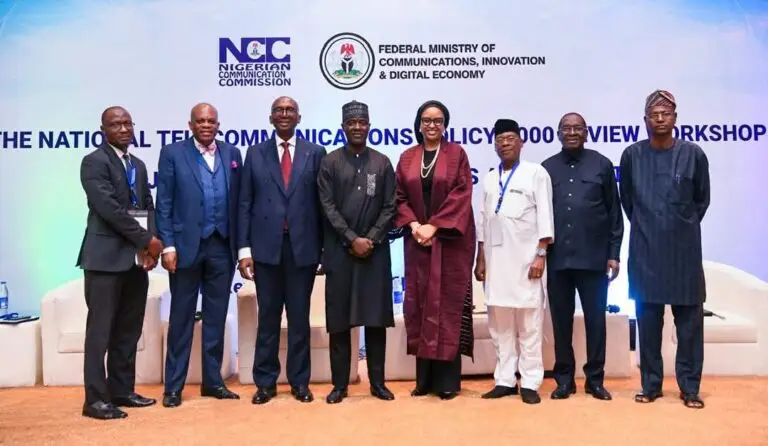
The Nigerian Communications Commission (NCC) has commenced a stakeholder-driven review of the National Telecommunications Policy (NTP) 2000 as part of efforts to strengthen Nigeria’s digital economy and position the telecommunications sector for emerging technological realities.
The NTP 2000 served as the foundation for the liberalisation of Nigeria’s telecommunications industry, ending the monopoly of the state-owned Nigerian Telecommunications Limited (NITEL), opening the sector to private investment, and paving the way for the introduction of Global System for Mobile Communications (GSM) services.
At a two-day Policy Review Workshop held at the Marriott Hotel in Ikeja, Lagos, the commission brought together key industry stakeholders to assess the achievements recorded since the policy’s introduction and chart a new course for Nigeria’s digital future.
Speaking at the workshop, the Executive Vice Chairman (EVC) of the NCC, Dr. Aminu Maida, said the communications sector has evolved from a standalone industry into a critical driver of national development.
“There is, therefore, an urgent need for strong and forward-looking policy frameworks to regulate emerging technologies such as Artificial Intelligence (AI), satellite broadband, the Internet of Things (IoT), Critical National Information Infrastructure, digital sovereignty, network resilience, sustainable innovation, and Quality of Experience (QoE).
“The strategic digitisation of key sectors, including agriculture, manufacturing, transportation and trade, is projected to significantly boost Nigeria’s economy,” he said.
Citing data from the Global System for Mobile Communications Association (GSMA), Maida said digitisation could contribute an additional two per cent to Nigeria’s Gross Domestic Product (GDP), create about two million jobs, and generate approximately N1.6 trillion in tax revenue.
He also stressed the need for modern regulatory frameworks capable of addressing cybersecurity, data governance, digital financing and online safety in an increasingly interconnected digital ecosystem.
According to him, the review process presents an opportunity for stakeholders to assess the legacy of the NTP 2000 while identifying practical strategies for bridging the digital divide through collaborative implementation.
Discussions at the workshop also focused on building a resilient digital future that balances innovation, security and public trust, as well as examining international telecommunications policy models and global best practices. Participants further reviewed stakeholder feedback on policy proposals aimed at strengthening Nigeria’s digital communications framework.
In his presentation, Aliyu Aboki of the West Africa Telecommunications Regulators Assembly (WATRA) commended the NCC for convening the workshop, describing the review as timely for both the telecommunications sector and Nigeria’s broader economic transformation agenda.
“This engagement is particularly important because telecommunications policy has become far more than a sectoral policy. Today, telecommunications infrastructure and digital connectivity underpin national productivity, financial inclusion, innovation, public service delivery, economic competitiveness, regional integration, and participation in the global digital economy,” Aboki said.
Presenting a paper titled, “From Telecommunications Liberalisation to Digital Economy Transformation: International Policy Approaches, Best Practices, and Regional Imperatives for Nigeria and Africa,” Aboki noted that few sectors in Nigeria have witnessed the scale of transformation achieved in telecommunications since the liberalisation reforms introduced under the NTP 2000 and reinforced by the Nigerian Communications Act 2003.
Also speaking at the event, the Director-General of the National Broadcasting Commission (NBC), Charles Ebuebu, said the liberalisation policy transformed Nigeria’s communications landscape, expanding mobile connections from about 500,000 lines in 2000 to nearly 180 million subscribers today.
He noted that the communications sector has become a major driver of economic inclusion, youth innovation and national competitiveness, adding that technological convergence has blurred the traditional boundaries between telecommunications and broadcasting.
Ebuebu argued that the proposed National Telecommunications Policy 2026 must recognise telecommunications, broadcasting and digital services as interconnected pillars of Nigeria’s digital economy.
He recommended the establishment of a permanent Inter-Agency Digital Ecosystem Governance Framework to strengthen coordination among regulatory institutions through joint policy implementation, technical collaboration, information sharing and coordinated enforcement mechanisms.
“Establish a formal NCC-NBC Convergence Protocol within six months of policy adoption, covering joint service classification, spectrum coordination, and a single-window licensing process for converged services.
“Mandate the creation of a permanent Inter-Agency Digital Ecosystem Governance Framework, bringing together the NCC, NBC, NITDA, FCCPC and NFMC for quarterly coordination.
“Implementation timelines, institutional responsibilities, and measurable policy outcomes should be clearly defined within the final policy document.
“Adopt function-based, service-neutral licensing principles that regulate infrastructure, content, data and spectrum according to functional characteristics rather than platform type.
“Implementation of the Draft Policy 2026 should align with broader national priorities, including digital inclusion, affordable access, rural connectivity, economic diversification, youth empowerment, creative industry growth, national security and global digital competitiveness,” he said.
About Post Author