PAAU Professor Sani Abdullahi Calls for Stronger Institutions to Deepen Accountability
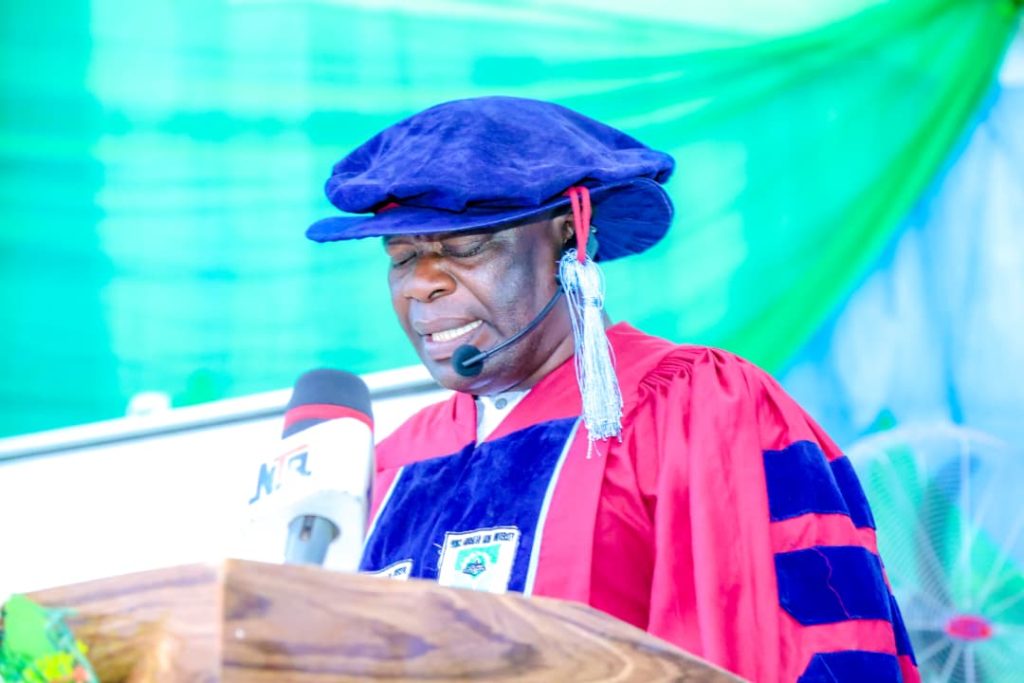
Professor of Accounting at Prince Abubakar Audu University (PAAU), Anyigba, Professor Sani Rufai Abdullahi, has called for stronger institutions, ethical leadership and value-driven governance to strengthen accountability, rebuild public trust and support sustainable national development.
Abdullahi made the call while delivering the university’s 24th Inaugural Lecture, titled “Epistemology of Accountability: Societal and Religious Concerns,” at the University Auditorium on Tuesday. The lecture examined the philosophical foundations of accountability and its societal and religious dimensions as essential pillars of good governance, ethical conduct and social transformation.
The accounting scholar described accountability as a cornerstone of moral and social order, arguing that trust, justice, transparency and responsible leadership depend on it.
He explained that the epistemology of accountability seeks to understand the nature, origins and justification of knowledge relating to responsibility, answerability and ethical behaviour in both individuals and institutions.
According to him, societal accountability is sustained through laws, institutions and social norms, while religious accountability extends beyond human systems by placing individuals under moral obligations before God.
Abdullahi maintained that accountability should go beyond compliance with rules and regulations to embrace integrity, stewardship, transparency and ethical consciousness.
He identified transparency, answerability and enforcement as the core attributes of accountability, noting that effective accountability operates through vertical, horizontal and social dimensions that promote good governance and institutional effectiveness.
Speaking on the societal dimension, the professor said responsibility to stakeholders, transparency, social justice, corporate social responsibility and good governance remain critical to building public confidence and achieving sustainable development.
Related NNews: Professor William Onogu Delivers PAAU’s 23rd Inaugural Lecture, Advocates Cultural Reawakening Through Folk Media
On the religious dimension, he said accountability is regarded across major world religions as a sacred obligation. He noted that Christianity teaches stewardship and responsibility before God, Islam emphasises hisab, under which individuals are answerable to Allah for their deeds, while Hinduism and Buddhism reinforce accountability through the doctrine of karma.
He said religious teachings provide a moral compass that promotes honesty, integrity, humility, justice and responsible leadership, even in the absence of external supervision.
The inaugural lecturer also examined the relationship between societal and religious accountability, identifying ethical governance, stewardship, sustainability, peacebuilding, conflict resolution and social cohesion as areas where both dimensions complement one another.
He, however, identified corruption, institutional weaknesses, conflicts of interest, ethical dilemmas, globalisation, technological disruptions, cultural relativism and declining moral values as major challenges confronting accountability.
“Addressing these challenges requires stronger institutions, transparent leadership, active citizen participation, effective legal frameworks and a renewed commitment to ethical values capable of restoring public confidence in governance and public institutions,” Abdullahi said.
He recommended integrating ethics, civic responsibility, accountability and moral education into primary, secondary and tertiary school curricula to nurture responsible citizens and future leaders.
The professor also called for greater autonomy, adequate funding and stronger enforcement powers for anti-corruption agencies, audit institutions and regulatory bodies.
He further advocated the adoption of digital governance platforms, open-data systems, blockchain-based record management and online audit trails to improve transparency, reduce corruption and strengthen public accountability.
Abdullahi urged religious organisations to intensify teachings on stewardship, honesty, justice and responsibility while working with governments and civil society groups to promote ethical behaviour across society.
He concluded that accountability is both a societal necessity and a moral imperative, urging governments, educational institutions, religious organisations, civil society and citizens to work together in building accountable institutions and value-driven communities.
Earlier, Chairman of the Inaugural Lecture Committee, Professor S.S. Arogba, congratulated Abdullahi on attaining the academic milestone and commended his contributions to scholarship in the accounting profession.
Vice-Chancellor of Prince Abubakar Audu University, Professor Salisu Ogbo Usman, described the lecture as another milestone in the institution’s academic history, noting that it was the seventh inaugural lecture delivered since he assumed office on February 11, 2026.
Related News: Professor Ogbo’s Inaugural Lecture Initiative: A Boost to PAAU Academic Excellence Profile
Usman said the lecture demonstrated that accountability should not be viewed merely as a technical or financial concept but as a body of knowledge rooted in ethical values, societal responsibility and religious convictions.
According to him, the lecture highlighted the interdisciplinary relationship between accounting, philosophy, sociology, religion and public ethics, while reinforcing the university’s commitment to producing knowledge that addresses societal challenges and promotes innovation, good governance and national development.
He reaffirmed the university’s commitment to excellence in teaching, research, innovation and character development through sustained support for impactful scholarship and interdisciplinary research.
The event concluded with the presentation of an inaugural lecture certificate, plaque and medal to Professor Abdullahi and was attended by members of the University’s Governing Council, government officials, management, Senate, academic and non-teaching staff, students, professional accountants, scholars, religious and traditional leaders, as well as other guests.
About Post Author