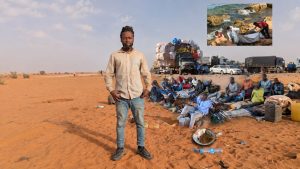
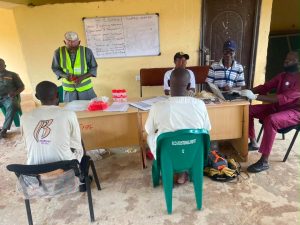
Fisayo Soyombo’s 47-Day Undercover Investigation: A Review
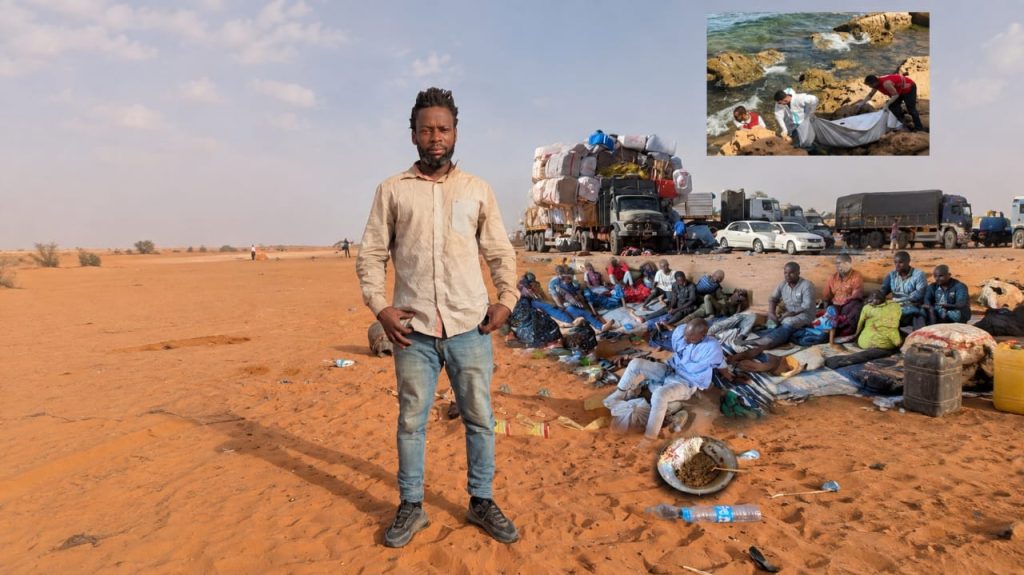
Fisayo Soyombo’s 47-day undercover investigation examines the dangers and exploitation facing migrants on the route from Africa to Europe.
It took me 48 hours of careful reading to fully understand the seriousness of Fisayo ‘Fisayo Soyombo investigative report for the Foundation for Investigative Journalism (FIJ). Titled “Europe Through the Sahara Desert and the Mediterranean Sea.”
The 47-day undercover investigation is more than a normal news report. It gives a frightening and detailed picture of the suffering faced by migrants trying to reach Europe.
For the safety and protection of the people involved, all personal names used in Soyombo’s investigation have been redacted, changed or replaced with pseudonyms.
The names used in the original investigation therefore do not represent the real identities of the migrants or other people involved. For this review, I will also avoid using those names and simply refer to them as migrants, travelers, survivors or captives.
Soyombo personally went through the journey, allowing the public to see, in a direct and painful way, a world that many people only hear about through news reports.
The beginning of the story shows how dangerous the journey through the Sahara Desert really is. It is not simply a difficult journey; it is a place where many people die without anyone knowing.
Through the stories of other travelers, Soyombo shows how many deaths never appear in official records. One migrant explains that only 25 out of 72 migrants survived a seven-hour journey on foot. Along the way, they saw human bones and dead bodies lying in the desert under the hot sun.
Another survivor tells of a terrible vehicle accident in Niger. Two people died immediately, while about 12 others were left bleeding in the sand for eight hours. By the time they reached Libya, only five of the 25 passengers were still alive.
These accounts show the terrible reality of a journey where human life can be lost so easily and where many deaths may never be properly recorded.
Soyombo’s writing makes the desert feel less like a simple route to Europe and more like a place where many desperate people are forced to risk their lives.
Read Part II Here and Part III Here
When the journey reaches Libya, the danger changes. Migrants are no longer only fighting the harsh desert; they are also facing serious cruelty from other human beings.
In holding places such as Ghut Shaal in Janzur, migrants are treated without basic respect or dignity. Soyombo describes how drivers throw bread and water onto the ground for migrants to pick up, almost as if they were feeding animals.
The migrants are kept inside fenced compounds controlled by local gang leaders and West African middlemen. They are forced to sleep on bare concrete floors or crawl under parked cars to protect themselves from the weather.
Violence is also common. Some migrants are beaten or slapped for very small reasons, such as speaking at the wrong time or wearing shoes inside the building.
These conditions show how quickly people can lose their basic dignity when they fall into the hands of criminal groups.
One of the most shocking parts of Soyombo’s investigation is his discovery of how organized and profitable human trafficking has become.
The movement of migrants is not always about helping them reach Europe. Instead, traffickers use them to collect money from their families.
At one holding location that looked like a mechanic workshop, traffickers demanded an exit fee of 1,350 dinars (about N232,740) from Soyombo and 1,450 dinars (about N249,980) from another migrant.
With many migrants being held in one workshop, the group could make about 40,500 dinars (about N7 million) every day from these payments. Wow!
This shows how migrants can become a source of regular income for criminal groups. The more desperate the migrants are, the more money the traffickers can demand from them and their families.
One of the most disturbing parts of the story is the behavior of the main captor. He regularly wore clean white clothes to attend Friday Jummat prayers, while at the same time keeping dozens of people locked up and demanding money from them.
The contrast is difficult to ignore: someone could publicly present himself as a religious person while privately treating vulnerable human beings with cruelty.
To move migrants through areas in Tripoli that are heavily watched by security forces, the traffickers use different tricks.
Migrants are hidden at the back of commercial trucks under water containers, plastic tables, and broken furniture. They are also made to wear dirty clothes covered with paint so that they look like factory workers.
These methods are used to make the migrants less noticeable and help traffickers move them through areas where they could be stopped or arrested.
Soyombo eventually escaped by air through Cairo after 47 days as part of a plan that had been prepared in advance. However, his story does not allow us to forget the people who remained behind.
One migrant described in the investigation became trapped in a repeated cycle of arrest, detention by armed groups, ransom payments, and unpaid work in places such as Ganapoli.
His experience shows that escaping one dangerous situation does not necessarily mean the journey is over. For some migrants, the cycle simply continues in another form.
Reading this story leaves a painful realization: irregular migration across the Sahara is not simply a journey based on hope. For many people, it becomes a carefully organized trap where human beings are treated as sources of money.
The investigation shows that the biggest danger on this journey is often not the desert itself. It is the system that makes money from desperate people.
Traffickers, border guards and middlemen can treat migrants not as human beings looking for a better life but as people from whom money can be taken through violence, fear and threats.
One of the most disturbing lessons is the false feeling of moving forward.
For many young Africans, paying a smuggler may seem like the first step toward a better life in Europe. They may believe that once they pay the required money and cross the desert, they are getting closer to their destination.
But Soyombo’s 47-day experience shows that the journey can instead lead people deeper into a cycle of extortion, detention by armed groups, unpaid work, repeated arrests and even death in the desert.
What looks like progress can therefore become another step into danger.
The situation also shows how difficult it can be for migrants to turn back. After spending large amounts of money, suffering abuse and traveling such a long distance, many may feel that they have no choice but to continue.
This can make them even more vulnerable to traffickers and armed groups.
Even those who survive the desert and cross the Mediterranean may later face deportation, serious emotional suffering or the painful realization that the journey cost them far more than they expected.
For some, the dream of reaching Europe may come with the loss of money, freedom, safety, dignity and sometimes the lives of people they traveled with.
In the end, ’Fisayo Soyombo’s courageous investigation brings attention to the hidden and dangerous route many people take in the hope of reaching Europe.
His 47-day undercover experience shows that the journey is not simply about crossing a desert or a sea. It exposes a wider system in which vulnerable people can be exploited for money at almost every stage of the journey.
The investigation also raises important questions about why so many young Africans are willing to take such dangerous routes in the first place. Poverty, unemployment, lack of opportunities, misinformation and the dream of a better life can all make the journey appear more attractive than the dangers involved.
But behind the promise of reaching Europe is a reality that many people may not fully understand before they begin: detention, violence, ransom demands, forced labor, hunger, death and years of suffering.
Soyombo’s undercover serves as a warning about the dangers hidden behind irregular migration through the Sahara and the Mediterranean.
As long as vulnerable young people continue to be pushed toward dangerous migration routes and criminal groups continue to profit from their desperation, the cycle of exploitation will remain difficult to break.
The Sahara, in his story, is not just a desert. It has become a symbol of the dangers faced by people who begin a journey with hope but can find themselves trapped in a system built on fear, exploitation and human suffering and sometimes eventual death.
– Abdulkadir Bin Abdulmalik is a writer, avid reader and a book reviewer who is passionate about ideas, storytelling and thoughtful conversations around books and society.
Email: abdulmalikabdulkadir@gmail.com
About Post Author