From Matagbamole to Oluomo: The Remarkable Journey of Oladele John Nihi

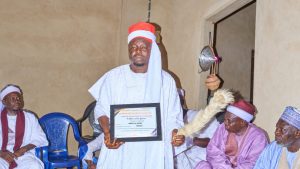
High Chief Oladele John Nihi, the Oluomo of Aiyegunle Gbede.
There is a popular Yoruba saying: “Tí ọmọdé bá fọwọ́ rẹ̀ mọ́, á bá àgbà jẹun,” meaning, “If a child washes his hands clean, they will dine with elders.” Few expressions could be more fitting in describing the remarkable journey of Oladele John Nihi, whose recent conferment as the Oluomo of Aiyegunle Gbede in Ijumu Local Government Area of Kogi State is not merely a recognition of his accomplishments but also a celebration of character, service and the enduring value of respect.
Back in our university days at Kogi State University, now Prince Abubakar Audu University, Anyigba, we fondly called him “Matagbamole,” meaning “Do not trample on the elder(s)”. It was a name that became part of our memories of those youthful years. Looking back today, there is something deeply significant about that nickname. As young people navigating the excitement, disagreements and occasional turbulence of campus politics, we were learning lessons about leadership, relationships and the importance of knowing how to engage those who had walked the path before us.
Years later, Nihi has demonstrated that the lessons of those days were not lost on him. Despite his growing political influence, expanding network of connections and increasing public responsibilities, his regard for elders and established institutions has remained an important part of his public identity.
From his days as a student leader to his emergence on the national political stage, Nihi has shown an increasing understanding of one important principle: political influence becomes more meaningful when it creates opportunities for others.
His journey through the National Youth Council of Nigeria, where he served as Chairman of the Kogi State Chapter and later became involved in its national leadership, provided him with opportunities to engage political leaders, policymakers and youth organisations across the country. These experiences helped him build relationships beyond his immediate constituency while keeping youth participation in governance at the centre of his advocacy.
His political connections have also crossed administrations and generations of leadership. From his engagements during the administration of former Governor Yahaya Bello to his appointment under Governor Ahmed Usman Ododo, first as Chief Press Secretary and subsequently as Special Adviser on Youth and Student Matters, Nihi has remained active within Kogi State’s political establishment.
However, what makes his journey particularly interesting is how he has sought to connect political access with youth development. Through his public engagements with student unions, the National Youth Council and other youth organisations, he has continued to encourage young people to participate in governance, acquire leadership skills and recognise their responsibilities in community development.
Beyond government office, the Oladele John Nihi Foundation provides another platform for this commitment. Its annual symposium brings together young people and experienced leaders to discuss governance, leadership and social development. The establishment of a youth hub in Lokoja, with facilities intended for training, mentorship, entrepreneurship and other developmental activities, further demonstrates an effort to translate relationships and influence into opportunities that can benefit the next generation.
His involvement in the establishment of the Okun Youth Alliance Movement also reflects his interest in mobilising young people at the grassroots, particularly around community participation, empowerment and representation.
Yet, Nihi’s influence has not been confined to Kogi State or Nigeria.
His emergence as Vice-President for West Africa of the Pan-African Youth Union took his advocacy to the continental stage, placing him within a network of youth leaders and institutions concerned with the future of young Africans. Through this platform, he has participated in regional initiatives aimed at strengthening youth leadership, dialogue, cooperation and engagement with policymakers.
His involvement in the West Africa Youth Security Summit and broader Pan-African youth engagements illustrates how his work has extended beyond domestic politics into discussions affecting young people across national boundaries. His international exposure has also connected Nigerian youth advocacy with wider continental and Commonwealth conversations on leadership and development.
For someone whose leadership journey began even before the university environment, that progression carries an important lesson. The relationships we cultivate, the respect we demonstrate and the bridges we build can open doors far beyond what we imagine in our younger years.
And this brings me back to Matagbamole.
There is a difference between respecting elders and surrendering one’s convictions. Respect does not require a young person to abandon ambition, silence independent thought or avoid challenging established ideas. Rather, it teaches us that disagreement need not become disrespect, that ambition can coexist with humility and that meaningful progress often requires cooperation across generations.
In my view, this has been one of the defining lessons of Nihi’s public journey. He has continued to pursue leadership opportunities while recognising the relevance of elders, traditional authorities and experienced political figures. He has also sought to use the relationships available to him to advance causes associated with young people.
That is why his installation as the Oluomo of Aiyegunle Gbede on 29 October 2026 carries a special significance.
It is a moment when a community publicly recognises one of its sons and entrusts him with an additional responsibility to serve, unite and contribute to its development. It is also a reminder that traditional honour comes with expectations beyond personal achievement.
The boy we once called Matagbamole has grown into a man honoured by the elders of his community.
What a beautiful illustration of the Yoruba wisdom: “Tí ọmọdé bá fọwọ́ rẹ̀ mọ́, á bá àgbà jẹun.”
Indeed, when a child washes his hands clean, he will dine with elders.
As I reflect on his journey from Lokongoma, our university days to the corridors of government, continental youth leadership and now traditional recognition, I see a story of ambition, relationships, perseverance and the responsibility that comes with influence.
Congratulations, High Chief Oladele John Nihi, the Oluomo of Aiyegunle Gbede.
May this new honour strengthen your commitment to the development of your community, the advancement of Nigerian youths and the broader aspirations of young Africans. May the doors that have opened to you continue to become pathways of opportunity for others.
Above all, may you never lose the humility, respect for elders and sense of purpose that make this moment particularly meaningful to those of us who remember your journey from the beginning.
From Matagbamole to Oluomo, the journey continues.
Once again, congratulations, OJN.
Written By Abdulkerim Haruna (Kerry)
About Post Author