Professor Jibrin Calls for Context-Sensitive Approach to Nigerian Literary Analysis
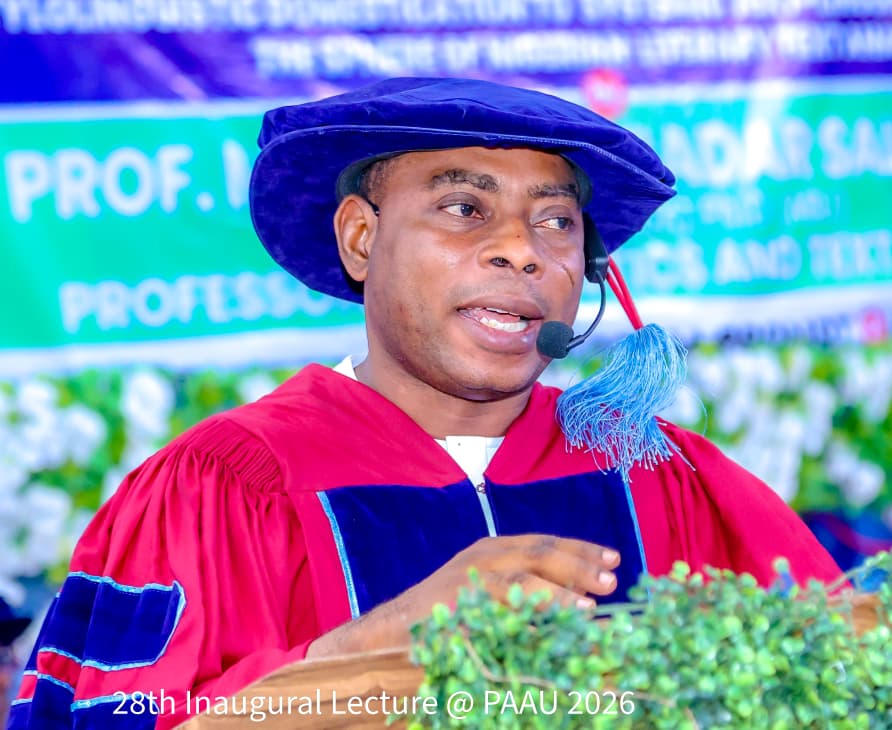
Professor Muhammed-Badar Salihu Jibrin delivers the 28th Inaugural Lecture of Prince Abubakar Audu University, Anyigba.
Professor Muhammed-Badar Salihu Jibrin, Professor of Stylistics and Text Linguistics at Prince Abubakar Audu University (PAAU), Anyigba, has called for the adoption of context-sensitive approaches to Nigerian literary analysis, arguing that existing theoretical frameworks must better reflect the country’s linguistic and cultural realities.
Jibrin made the call on Tuesday, September 22, 2026, while delivering the 28th Inaugural Lecture of PAAU at the University Auditorium, Anyigba.
The lecture, titled “From Stylolinguistic Domestication to Systemic Text Linguistics: A Journey Through the Sphere of Nigerian Literary Text Analysis,” examined the evolution of approaches to analysing literary texts and the need for frameworks capable of capturing Nigerian experiences, identities, histories and worldviews.
Jibrin noted that style and stylistics have historically attracted different definitions, creating methodological challenges over how writers’ linguistic choices and their functions should be examined within particular social contexts.
He argued that Nigerian literature, because of its diverse cultural and linguistic experiences, requires analytical tools that are sensitive to local realities.
According to him, language should be understood both as a system and as a resource for creating meaning, making it necessary for stylistic analysis to consider not only the choices made by writers but also why those choices are made and the functions they perform.
He also examined the development of English in Nigerian literature, noting that although the language was introduced into the country within a different cultural context, Nigerian writers have adapted and nativised it to express African and Nigerian experiences.
Drawing from his previous research on Chukwuemeka Ike’s Our Children Are Coming, Jibrin examined the use of literary devices including parallelism, coinages, collocations, names and titles.
He cited expressions such as “Whitemail,” “Youthquake,” “Kwashiorkor” and “Chop-Chop Mentality” as examples of linguistic choices used to expose human apostasy and societal vices.
He said such stylistic devices and collocations could project themes including moral decay, hypocrisy and corruption, while also demonstrating resistance, reform and the creative capacity of Nigerian writers using English as a second language.
In his analysis of Olu Obafemi’s Wheels, the inaugural lecturer examined the roles of nativisation, code-mixing, lexical repetition and character-based speech in modifying English through the influence of oral traditions and Afro-Nigerian thought processes.
Jibrin said the linguistic choices found across Nigerian literary texts often reflect the social conditions and dialects of their communities, demonstrating the flexibility of nativised English as a medium for carrying African thought and culture.
On systemic text linguistics, he discussed the application of M.A.K. Halliday’s Systemic Functional Linguistics and Beaugrande and Dressler’s Seven Standards of Textuality in analysing texts as unified semantic units within specific contexts.
He also highlighted Adejare’s model, which analyses literary texts at the Primitive, Prime Order and Second Order levels to examine meaning from basic linguistic choices to complex fictionalised social situations.
Jibrin said systematic analysis of literary idiolects, referring to the language patterns of individual authors, and literary dialects, involving patterns shared across multiple authors, could reveal recurring linguistic structures and help establish meaning across diverse texts.
He proposed a comprehensive Systemic Text-Linguistic approach built around textuality, regulative principles, semiotic variations, levels of meaning projection and contextual functionality.
The approach, he explained, incorporates the seven standards of textuality — cohesion, coherence, intentionality, acceptability, informativity, situationality and intertextuality — alongside principles of efficiency, effectiveness and appropriateness.
Jibrin further argued that academic scholarship should move beyond rigid Western paradigms towards frameworks that are responsive to local contexts and capable of strengthening classroom practice, curriculum development and language education.
He said text and system were inseparable in the study of language and called for indigenous expressions, loan words, discourse particles and local varieties of English to be recognised as important elements of authentic literary expression and cultural preservation.
According to him, language analysis should not be limited to abstract grammatical correctness but should also contribute to understanding human experience, building linguistic confidence and preserving national heritage.
In his address, the Vice-Chancellor of PAAU, Professor Salisu Ogbo Usman, represented by the Deputy Vice-Chancellor (Administration), Professor Rufai Sani Abdullahi, described the 28th Inaugural Lecture as an important milestone in the university’s commitment to scholarship and intellectual engagement.
Usman said the lecture traced an intellectual movement from borrowed stylistic paradigms to systemic and context-sensitive approaches to text linguistics, describing the subject as relevant to contemporary scholarship and the humanities.
He congratulated Jibrin on the lecture and commended his focus on the relationship between language, cultural identity and knowledge production.
Read Also: PAAU Inaugural Lecture: Prof. Egwemi Calls for Polycrisis-Responsive Performance Curriculum
The Vice-Chancellor said bridging theoretical frameworks and local realities was an important intellectual responsibility, adding that scholarship should extend beyond lecture halls to serve humanity and promote appreciation of Nigerian literature.
He added that the lecture provided useful perspectives for educators, policymakers and researchers as the university continues to promote knowledge production, preservation and application.
Usman reaffirmed the university’s commitment to research, teaching and the dissemination of knowledge across disciplines.
The event ended with the presentation of the inaugural lecture certificate, plaque and medal to Professor Jibrin.
The lecture was attended by members of the University Governing Council, Management and Senate, academic and non-teaching staff, students, traditional and religious rulers, as well as other guests from within and outside the university community.
About Post Author