5th Cycling Lagos Webinar: Experts Call for Investment, Policy Enforcement to Unlock Nigeria’s Recycling Potential
Environmental advocates, waste managers, recycling practitioners and private-sector stakeholders have called for stronger policy enforcement, increased investment, long-term financing, improved infrastructure, technology adoption and behavioural change to unlock Nigeria’s recycling potential and transform waste into economic value.
The stakeholders made the call at the 5th Cycling Lagos Webinar, held on Thursday, September 3, 2026, as part of activities leading up to the 5th Cycling Lagos scheduled for Saturday, September 12, 2026, at the National Stadium, Surulere, Lagos.
The webinar, themed “Trash to Treasure: Unlocking Recycling Capacity for a Sustainable Future,” brought together industry experts and stakeholders to examine practical ways of expanding recycling capacity, strengthening the circular economy and addressing Nigeria’s growing waste management challenges.
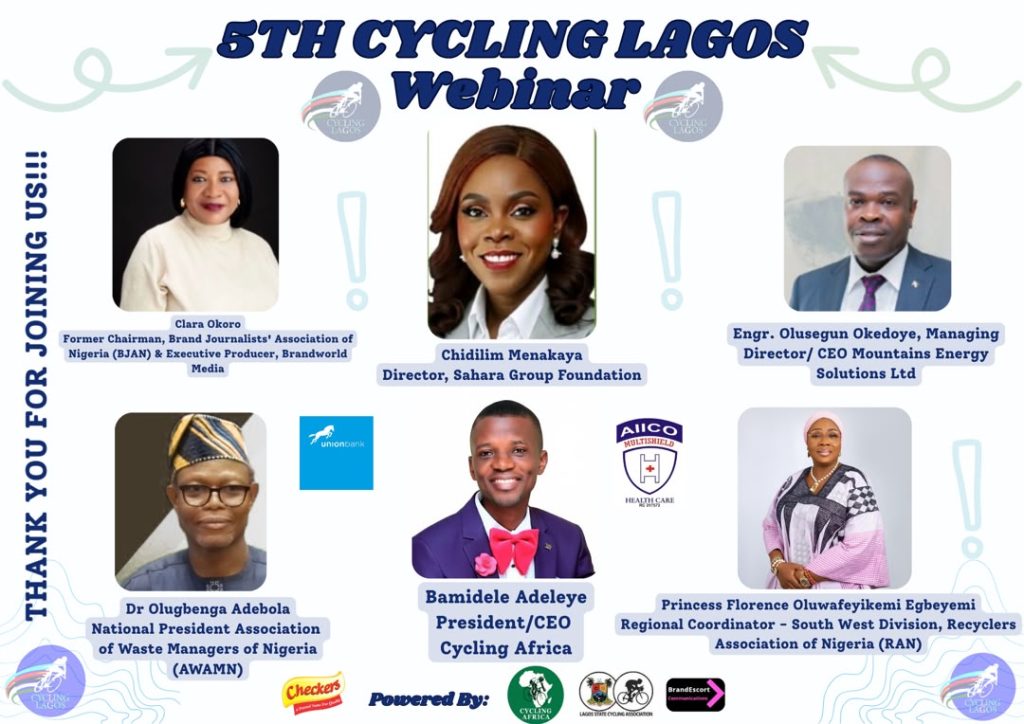
Speaking at the event, the National President of the Association of Waste Managers of Nigeria (AWAMN), Dr. Olugbenga Adebola, said Nigeria must stop treating waste solely as an environmental problem and begin to recognise it as an economic resource.
“Waste is not waste unless you waste it. For a very long time, whether in Lagos, across Nigeria or across the continent of Africa, we have been wasting our waste,” he said.
Adebola stressed that accurate data was critical to effective waste management planning, particularly in Lagos, where he said current estimates may not adequately reflect the actual volume of waste being generated.
According to him, planning for approximately 13,000 metric tonnes of waste when actual generation exceeds 20,000 metric tonnes creates a significant deficit in collection, transportation, processing and disposal infrastructure.
He noted that although approximately 18 per cent of waste generated in Lagos is currently recycled, the figure remains low considering the enormous volume of recyclable materials entering the waste stream.
While acknowledging Lagos State’s pioneering role in waste recovery and recycling, including the promotion of the Three Rs — Reduce, Reuse and Recycle, Adebola identified infrastructure, financing and policy implementation as major constraints to the sector’s growth.
Read Also: Union Bank, AIICO Multishield, Checkers Custard Back 5th Cycling Lagos
He said waste management and recycling were highly capital-intensive businesses requiring affordable, long-term financing to attract and retain private investment.
“I have invested hundreds of millions of naira into recycling, and I am not making what I am supposed to be making. If I had gone to the bank to borrow the money, I would be in trouble today,” he said.
Adebola advocated financing arrangements of between 10 and 15 years, noting that short-term commercial bank loans and high interest rates were unsuitable for funding large-scale waste management and recycling infrastructure.
He cited the cost of a new compactor, which he said could exceed N150 million, as evidence of the scale of capital required in the sector.
He called for stronger government-private sector collaboration, including long-term concession agreements that would provide investors with sufficient certainty to commit substantial capital.
Adebola also highlighted the economic contribution of the private sector, disclosing that AWAMN members had collectively contributed to the creation of more than 30,000 direct and indirect jobs across waste collection, transportation, vehicle maintenance and related activities in Lagos.
He further highlighted the role of workers operating behind collection trucks in recovering recyclable materials, saying they account for a significant proportion of recyclables recovered in Lagos.
Investment, Behavioural Change Critical
The Director of Sahara Group Foundation, Chidilim Menakaya, also called for increased investment in recycling infrastructure, technology, financing and public education.
Menakaya explained that Sahara Group Foundation serves as the social impact vehicle of Sahara Group, leveraging an “Extrapreneurship” strategy that combines economic and community empowerment initiatives through strategic partnerships.
She said the Foundation’s interventions align with the 17 Sustainable Development Goals, noting that more than two million people have benefited from the Group’s social impact projects and initiatives.
Speaking on the topic, “Trash to Treasure: The Role of the Private Sector in Unlocking Recycling Capacity for a Sustainable Future,” Menakaya described the country’s growing waste stream as both an environmental challenge and an economic opportunity, saying that the private sector has a critical role to play in bringing capital and investment into the sector to drive its transformation.
“Most of this waste is actually wasted instead of being turned into opportunities,” she said.
She stressed the need for a more structured system of collection, sorting and recovery that would prevent recyclable materials from ending up in landfills and instead channel them into productive economic activities.
According to her, the recycling value chain requires coordinated investment in collection systems, sorting and recovery facilities, recycling trucks, processing plants, technology and reliable off-takers.
“The government has a part to play in ensuring that we have the right policies, while the private sector brings capital and investment,” she said.
Menakaya, however, warned that infrastructure and investment alone would not solve Nigeria’s recycling challenge without behavioural change.
“If the public do not understand the reason why they have to recycle, there is no need for you to put infrastructure in place,” she said.
She called for stronger community education and sensitisation to communicate the environmental, personal and economic benefits of recycling.
Menakaya also urged entrepreneurs and young people to see waste collection and aggregation as viable businesses.
“A lot of people have not understood that collection is a big business and that collection is a profitable business,” she said.
She advocated increased financing for viable recycling businesses and youth-led green enterprises, alongside improved access to land, technology, infrastructure and appropriate standards.
According to her, government could support the sector by making suitable land available for recycling businesses, thereby reducing one of the significant operating costs faced by recyclers.
Technology Can Close Capacity Gap
Menakaya also highlighted the importance of technology and innovation in improving the efficiency of Nigeria’s recycling value chain.
She disclosed that Sahara Group Foundation operates an in-house recycling dashboard that allows its partners and communities to monitor recycling data in real time across different hubs and locations.
She also cited reverse vending machines and other technologies for automated collection, sorting and cleaning of recyclable materials as examples of innovations capable of improving efficiency.
However, she advised entrepreneurs not to wait until they could afford expensive, large-scale technology before entering the sector.
“Start small, and see how you can then scale up,” she advised.
She said strategic partnerships could also help overcome logistical challenges, including the movement of recyclable materials from collection points to aggregation and processing facilities.
Recycling Must Become Industrial Policy
The Regional Coordinator, South-West Division of the Recyclers Association of Nigeria (RAN), Princess Florence Oluwafeyikemi Egbeyemi, said Nigeria needed to fundamentally change its approach to recycling by moving beyond waste collection to industrial transformation.
Speaking on the topic, “The Role of Recycling in Nigeria’s Circular Economy”, she described recycling as more than a sanitation programme, saying it should be treated as industrial policy, urban infrastructure and resource security.
“The question is: how do we move from simply collecting waste to transforming it into reliable industrial value? That is the journey from waste collection to industrial transformation,” she said.
According to Egbeyemi, Nigeria is generating enormous quantities of materials while industries simultaneously require reliable raw materials, creating an opportunity to connect waste recovery with industrial production.
She said the real measure of success should not simply be the quantity of waste collected but the volume of recovered materials transformed into specification-grade feedstock that industries are willing to purchase.
“Waste becomes material. Material becomes feedstock. Feedstock becomes product. And product creates value,” she said.
She argued that a tonne of recovered material sitting in a warehouse does not necessarily constitute economic success unless it can be processed into quality material with a reliable market.
Egbeyemi identified poor product design, inadequate source separation, inefficient collection and logistics, contamination, insufficient processing equipment, energy challenges, inadequate working capital and unstable markets as some of the points where value is lost across the recycling chain.
She therefore proposed a simple investment equation:
Predictable feedstock + predictable quality + predictable buyer = bankability.
She also called for better implementation of Extended Producer Responsibility (EPR), arguing that EPR funding should be linked to measurable outcomes rather than merely activities.
According to her, stakeholders should be able to determine how much material was recovered, its quality, where it went and the economic and environmental outcomes generated.
Informal Sector Must Be Integrated
Egbeyemi also urged stakeholders to recognise the informal recycling sector as an existing component of Nigeria’s recycling infrastructure rather than seeking to eliminate it.
She noted that waste pickers, collectors, aggregators and traders already perform critical functions within the recycling value chain.
She called for the sector to be upgraded and professionalised through contracts, traceability systems, protective equipment, training, access to finance and improved digital records.
“A successful circular economy should create more productive, safer and more dignified jobs,” she said.
She further advocated material-specific recycling strategies, noting that plastics, metals, paper, organics, e-waste and construction waste require different technologies, infrastructure, standards and business models.
Egbeyemi also proposed a South-West regional circular economy model connecting Lagos, Ogun, Oyo, Osun, Ondo and Ekiti, with households and businesses generating materials, collection systems recovering them, aggregation hubs consolidating them, processors transforming them and manufacturers purchasing the resulting materials.
She said the South-West could serve as a demonstration corridor for an integrated circular economy model that could subsequently be replicated across Nigeria.
Looking ahead, she proposed a long-term pathway in which Nigeria could focus by 2031 on building infrastructure of trust, move towards circular manufacturing by 2036, and make circularity an integral part of the operating system of Nigerian cities and industries by 2051.
She stressed that the timelines were proposed ambitions rather than existing government targets.
Egbeyemi also urged Nigeria to position itself as a potential African circular materials hub, leveraging its large domestic market, manufacturing base, young workforce, recoverable material flows and opportunities presented by the African Continental Free Trade Area (AfCFTA).
“Circularity should become a competitiveness strategy—not simply a compliance burden,” she said.
She identified data, source separation, infrastructure, finance, markets and people as the six critical pillars required to build a functioning circular economy.
“If any one of these pillars fails, the chain becomes weaker. The execution principle I would leave with investors, policymakers and operators is simple: build the weakest link first,” she said.
She concluded with a warning and a call to action:
“We are not running out of waste. We are running out of time to waste it.”
Government Must Enforce Policies and Build Infrastructure
The Managing Director/CEO of Mountains Energy Solutions Ltd, Engr. Olusegun Okedoye, identified weak policy enforcement, inadequate infrastructure, limited public awareness and cultural attitudes towards waste as major barriers to unlocking Nigeria’s recycling potential.
Okedoye acknowledged that government had introduced several policies aimed at improving waste management and recycling but said the major challenge remained implementation and enforcement.
“Government has a lot of policies, there is no doubt about it, but the enforcement of those policies is nearly non-existent,” he said.
He called for a sustainable infrastructure development programme that would go beyond one-off government interventions and provide a comprehensive, adequately funded and consistently implemented framework for waste segregation, collection, processing and recycling.
According to him, Nigeria also needs to change its cultural perception of waste by making waste management and recycling education part of the national consciousness.
“We need to get the concept of waste management synchronised into our consciousness, from primary school to tertiary institutions, and have a reorientation shift. It is not completely left to government. Everybody must be involved,” he said.
Okedoye advocated sustained environmental education and public sensitisation from the grassroots, arguing that Nigerians should understand not only how to dispose of waste responsibly but also the economic opportunities embedded in the recycling value chain.
He also called for stronger collaboration between Nigerian businesses and international technology companies to facilitate technology transfer, improve processing capacity and strengthen local expertise.
According to him, a predictable policy environment, fiscal alignment, foreign exchange stability, ease of capital movement and the ability to repatriate investment returns would help attract more domestic and foreign investment into Nigeria’s recycling sector.
Building a Sustainable Circular Economy
Across their various presentations, the experts agreed that Nigeria’s recycling challenge cannot be solved by government alone.
They called for a coordinated ecosystem involving government, private investors, manufacturers, recyclers, waste managers, informal-sector operators, communities, educational institutions, development finance institutions and consumers.
The stakeholders stressed that Nigeria needs accurate data, effective policy enforcement, source separation, modern infrastructure, affordable long-term financing, technology, reliable markets, strong EPR implementation, public education and professionalised human capital to unlock the full value of its recycling sector.
They also emphasised the need to make recycling economically viable through cost-reflective tariffs, stable pricing mechanisms, government-backed guarantees, long-term concessions and reliable offtake arrangements.
Adebola stressed that investment would only flow into the sector when investors were confident of achieving reasonable economic returns.
“Investment will go where investors are 100 per cent certain that they will achieve a viable economic return,” he said.
The experts warned that failure to address the recycling capacity gap would continue to contribute to flooding, blocked drainage, environmental and public health challenges, lost raw materials, higher municipal costs and missed opportunities for job creation and investment.
They nevertheless expressed optimism that Nigeria could transform its waste challenge into an industrial and economic opportunity if stakeholders worked together to strengthen the weakest links in the recycling value chain.
Cycling Africa: Turning Conversation into Action
In his opening remarks, the President/CEO of Cycling Africa Limited and Convener of Cycling Lagos, Mr. Bamidele Adeleye, said the “Trash to Treasure” theme was inspired by the urgent need to address Lagos’ growing waste challenge while unlocking the economic opportunities within the recycling value chain.
Adeleye noted that Lagos generates millions of tonnes of waste annually, including a significant volume of plastic waste, stressing that the challenge should not be viewed solely as an environmental burden.
He said a substantial portion of the waste stream could be recovered, recycled, reused and transformed into economic value, creating opportunities for businesses, jobs and sustainable development.
According to him, Cycling Lagos has always been more than a sporting event, using cycling as a platform to promote healthy living, environmental consciousness, sustainable transportation and stronger communities.
He explained that the “Trash to Treasure” campaign represents an extension of that vision, using sport and community engagement to stimulate conversations and practical action around environmental sustainability and the future of Nigerian cities.
He urged participants and stakeholders to translate the discussions into concrete actions, emphasising that the waste generated today represents not only an environmental challenge but also an economic opportunity waiting to be unlocked.
The webinar was moderated by Clara Okoro, Former Chairman, Brand Journalists’ Association of Nigeria and Managing Director Brand World TV
The 2026 edition of Cycling Lagos will hold on Saturday, September 12, 2026, at the National Stadium, Surulere, Lagos, and is expected to attract cyclists, environmental enthusiasts, corporate organisations, government representatives and other stakeholders.
The 5th Cycling Lagos is organized by Cycling Africa Limited in collaboration with Lagos State Cycling Association. The event is sponsored by Union Bank of Nigeria Plc and supported by AIICO Multishield Limited, Checkers Custard, Flour Mills of Nigeria Plc, Stanbic IBTC, BrandEscort among others.
For sponsorship, partnership and participation enquiries, visit www.cyclinglagos.com or contact info@cyclinglagos.com.
About Post Author